The recent events highlight growing social frustration among Moroccan youth and marginalized communities. They also raise important questions about Morocco’s economic and social policies and whether they are addressing the aspirations and needs of a generation increasingly looking for opportunities beyond its borders.
Harga or Harraga, a frequently heard term in Morocco often described as “burning the borders,” is becoming increasingly used and could easily get out of control in being acted out. For some, Harraga is a way of calling attention to the social and economic frustrations facing Morocco today. For others, it has become a normalized way of expressing the desire for a better life outside the country. What is important is that Harraga is no longer limited to the poor or marginalised. The term and the phenomenon have become familiar across different social and economic groups in Morocco.
Harraga as a Dream:
Bilal, a 24-year-old unemployed man from Tangier, says he is seriously considering irregular migration despite having a mother who works and financially supports him. For Bilal, the issue is not simply finding a job. He believes that Morocco cannot offer him the life and income he wants and sees Europe as a chance to completely change his future.

One of the strongest parts of his testimony is his description of migration as more than an economic decision. When asked whether he would reconsider if he found a good job in Morocco, he said: “No, I would not reconsider the idea of migration. I am obsessed with migration because, for me, it is a dream or paradise.”
Bilal also acknowledges the dangers but says that when someone believes there is no future for them at home, they begin to think those risks seem worth taking.
“When a person is convinced that he has no future here, he begins to think differently,” Bilal says.
His comment shows how the idea of Europe can become deeply rooted in a young person's imagination, even when the person has limited qualifications and no concrete employment opportunity waiting abroad.
Harraga as an obsession:
Hassan, 25, has a very different view. He owns a small grocery shop in Tangier and believes that some people in his generation and younger focus too much on what they imagine Europe can offer instead of trying to build something at home.
His message is not that Morocco offers perfect opportunities. Rather, he believes that young people have to start somewhere, even if the work and income are modest. As he puts it: “A person can start from zero. I have a small grocery shop. Yes, I have not become rich because of it, but I work and earn my living with my own hands.”
Hassan also challenges what he sees as an idealized image of Europe. He argues that some young people see migration as an easy path to money and a comfortable life without considering the cost of living, housing, taxes, and the difficulty of finding work.
His strongest criticism is directed at what he calls the “obsession with migration.” He advises:
“Do not make illegal migration an alternative to work. Learn a trade, work, try to start a small business, and develop yourself.”
Understanding Harraga Beyond Unemployment
Sociologist Abderrahim Anbi of Mohammed V University in Rabat told Atlas Broadcasting that the events surrounding thousands of Moroccan immigrants storming Spain's Ceuta reveal a deeper frustration among a significant segment of Moroccan youth. While Morocco has undergone major economic and infrastructural transformation, many young people continue to experience unemployment, uncertainty, and limited opportunities for social mobility.
For Anbi, the issue is not simply the absence of development, but whether young people feel that they can participate in that development and build a secure future. He points to a growing disconnect between national transformation and the everyday experiences of some young people, particularly those who feel that political institutions have not adequately addressed unemployment, inequality, and social insecurity.
Anbi also emphasizes that migration cannot be explained by economic hardship alone. Europe, and Spain in particular, can become a powerful symbol of opportunity, social mobility and a different future.
As one migrant described his situation, “I have jobs, but no future.”
For Anbi, this captures an important distinction: having employment does not necessarily mean having a sense of stability, dignity, or a future worth building.
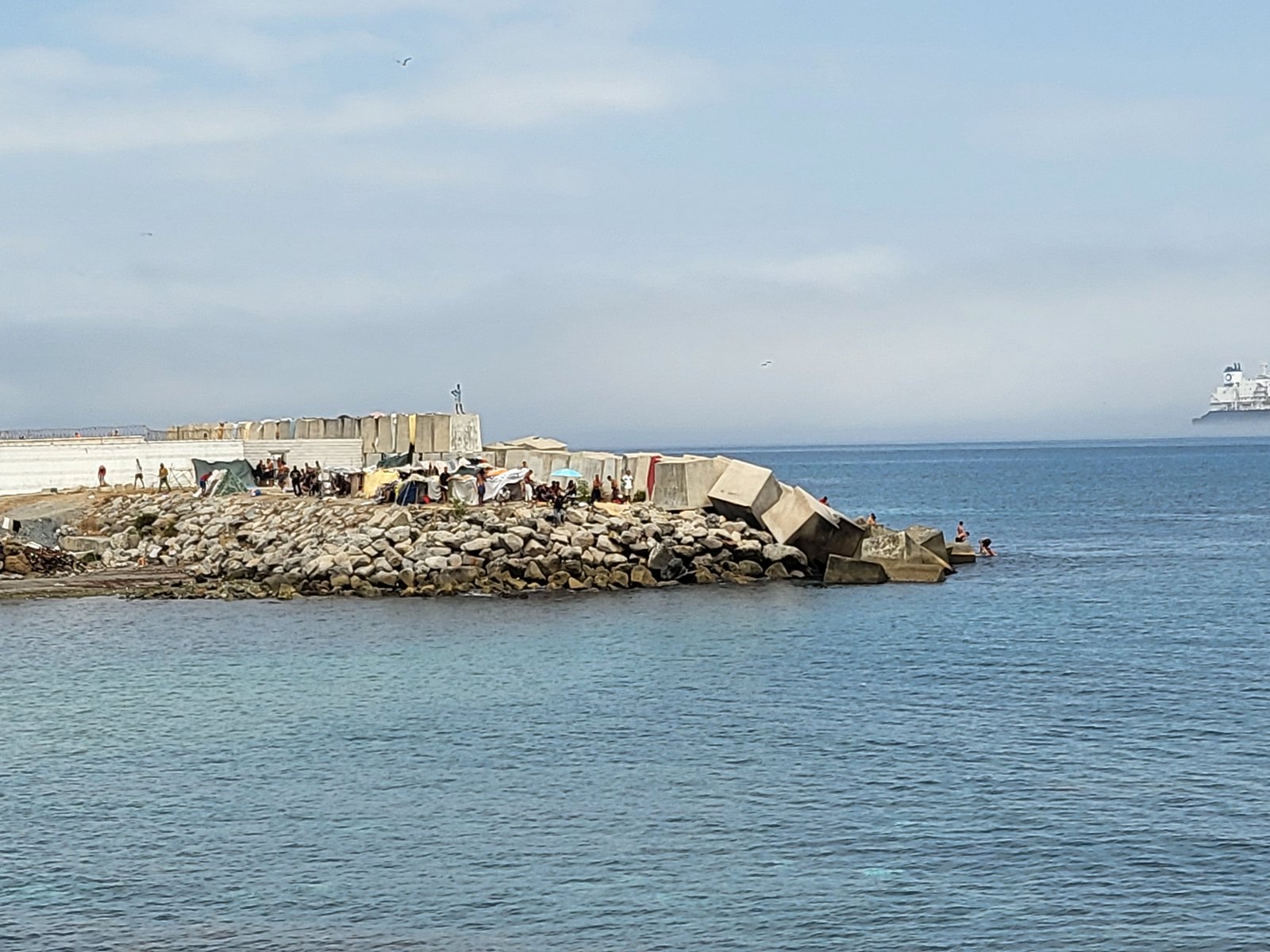
The Ceuta episode in July, when tens of thousands tried to crash through immigration barriers, many having traveled by sea, also demonstrated the powerful role of social media. Rumors circulating on Facebook, Instagram, and TikTok convinced thousands that the border had become accessible. According to Anbi, social media did not create the desire to migrate, but “synchronized” an aspiration that already existed, bringing many individuals together around pursuing the same perceived opportunity.
He argues that Harraga should therefore be understood as more than a response to poverty. For some young people, it represents an attempt to change their social position, gain recognition, and construct a different future. The status associated with being someone who has lived abroad, or Nas El-Kharij, can reinforce the idea that migration offers not only economic improvement but also social recognition.
Anbi also sees a political dimension. Harraga can reflect frustration with institutions and a feeling that existing political and social structures have failed to provide meaningful opportunities, he says. In this sense, he points out that irregular migration can become a form of “political refusal” or rejection of conditions that young people feel unable to change at home.
At the same time, Anbi cautions against treating Harraga as representative of all Moroccan youth. The July Ceuta events should not be interpreted as evidence that Moroccan youth as a whole have lost hope or want to leave their country.
Rather, they reveal the frustrations and aspirations of a significant segment of young people whose expectations may be increasingly disconnected from what they believe is realistically available to them.
Ultimately, Anbi describes Harraga as an expression of both hope and frustration: hope for money, freedom, dignity, and a better future, and frustration with precariousness, inequality, limited opportunities. and political disconnection. As he puts it, “A crisis does not automatically produce a mental crisis.”
The persistence of the desire to migrate, even as borders become harder to cross, suggests that the phenomenon is driven by aspirations and perceptions of the future as much as by economic conditions.
Conclusion
Morocco is not an exception when it comes to irregular migration. Yet, the Ceuta episode brought the Harraga phenomenon into the open and revealed the different layers of Moroccan society and the different ways young people understand migration. For some, it represents economic opportunity; for others, it is a way to escape frustration, seek dignity, gain independence, or imagine a different future.
More than 72,000 people reportedly entered Ceuta from Morocco between July 30 and 31 with the first wave largely made up of young Moroccans, many between the ages of 15 and 25.
This also shows that Harraga is more complicated than simply wanting to leave Morocco. It reflects a deeper gap between the aspirations of some young people and the opportunities they believe are available to them at home.
For this reason, it is more important than ever for Morocco's government to take this issue seriously, not only by improving the economy and creating more opportunities for young people, but also by developing updated programs that address the social and psychological dimensions of migration. Young people need to feel more involved in their communities and society, while education and public programs should encourage a stronger sense of belonging, self-worth, and pride in their communities and country.
Ultimately, addressing Harraga requires more than controlling borders. It requires understanding why some young people no longer see a future for themselves at home and creating the conditions that can make that future feel possible.
Omar Sadouky reported from Tangier, Morocco